
Pontoon vs. Tritoon: What’s the Difference and Which Boat Is Right for You?
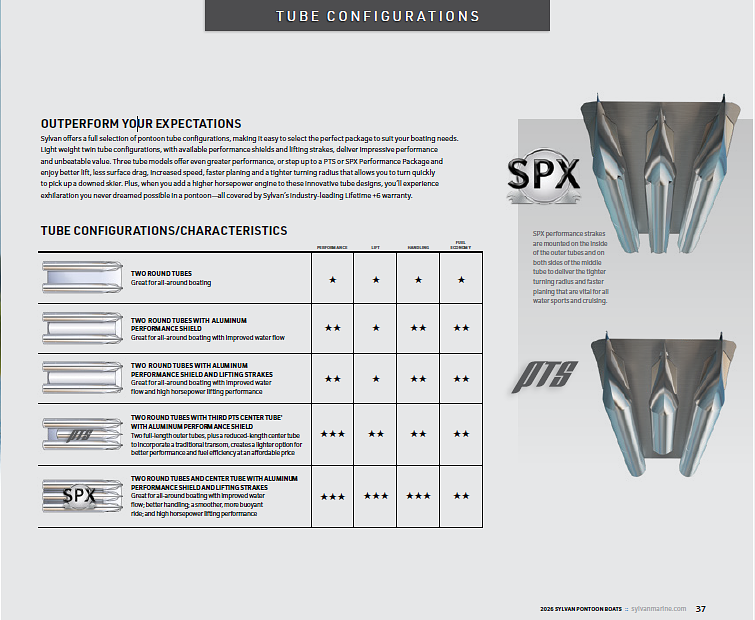
If you are shopping for a versatile boat for cruising, entertaining, fishing, or watersports, you will quickly run into two popular options: the pontoon and the tritoon. At a glance they look similar—both offer spacious decks, comfortable seating, and a stable ride—but the hull design changes how each boat performs on the water. Sylvan offers several different tube options for you, but deciding which one you need can be a hard decision.
Below is a clear, practical breakdown of the key differences between a pontoon boat and a tritoon boat, including performance, ride quality, capacity, cost, and how to choose based on your boating plans.
What Is a Pontoon Boat?
A traditional pontoon boat rides on two aluminum tubes (pontoons) mounted under the deck. Those tubes provide buoyancy and stability, creating a wide, flat platform that is ideal for relaxing and socializing. Pontoons are known for easy handling at moderate speeds and for being one of the most family-friendly boat styles on lakes and calm waterways.
What Is a Tritoon Boat?
A tritoon is essentially a pontoon boat with three tubes instead of two. That third tube—typically mounted in the center—adds buoyancy, improves weight distribution, and allows for larger engines and higher speeds. Many tritoons also include performance features such as lifting strakes (metal fins on the tubes that help the boat rise and reduce drag) and under-skinning (panels beneath the deck that smooth water flow).
The Core Difference: Two Tubes vs. Three Tubes
The simplest way to understand pontoon vs. tritoon is this: the third tube changes how the boat sits in the water and how it responds under power.
- Pontoon: Two tubes; excellent stability at rest and comfortable cruising in calm conditions.
- Tritoon: Three tubes; better lift, more capacity for horsepower, and improved performance in turns and chop.
Performance and Speed
Performance is often the deciding factor. While both boat types can be enjoyable at cruising speeds, a tritoon typically delivers a noticeably more confident, sportier feel.
Pontoons commonly run well with smaller to mid-range outboard engines. They are great for relaxed lake cruising, anchoring in coves, and short hops between marinas. At higher speeds, a two-tube setup may feel less planted, especially when loaded with people and gear.
Tritoons can handle larger engines and often plane more effectively (depending on design). The added tube improves lift and can reduce bow rise during acceleration. If watersports, longer runs, or faster cruising is a priority, a tritoon is usually the better match.
Handling and Turning
Turning feel is another major distinction.
Pontoons tend to turn flatter and can “slide” more in sharper turns. That is not necessarily a problem for casual boating, but it can feel less controlled at higher speeds.
Tritoons generally offer more predictable handling and tighter, more confident turns. With three tubes, the boat has better lateral support, and many models are designed for higher-speed maneuvering.
Ride Quality in Rougher Water
If you boat on large lakes, windy reservoirs, or waterways where boat traffic creates consistent wake, ride quality matters.
Pontoon boats can do well in mild chop, but when conditions get bumpy, the wider two-tube stance may lead to more slap and bounce, especially at speed. You can still boat comfortably, but you may need to slow down more often.
Tritoon boats tend to bridge waves better and track more steadily in rougher water. The third tube helps support the center of the boat and can reduce hobby-horsing (the up-and-down pitching motion). The result is a smoother ride for passengers and a more secure feel at the helm.
Capacity and Weight Distribution
Both styles can be rated for impressive passenger counts, but a tritoon has an advantage when you routinely carry a full group.
Pontoons can feel slightly more sensitive to load placement—if everyone gathers on one side or at the stern, you may notice more list or squat.
Tritoons distribute weight more effectively due to the extra buoyancy. This can be helpful for:
- Large families or frequent entertaining
- Carrying coolers, water toys, and fishing gear
- Adding heavier options like larger fuel tanks, premium seating, or a full-length canopy
Horsepower Range and Watersports
Engine size influences not only speed, but also how confidently the boat handles when loaded and when pulling skiers or tubes.
Pontoon boats are often paired with modest horsepower that suits cruising and light towing. Some pontoons are configured for watersports, but the experience depends heavily on the specific hull design, tube diameter, and performance package.
Tritoon boats are frequently selected for watersports because they can accommodate higher horsepower and maintain speed better with a full crew onboard. If your priorities include wakeboarding, tubing with multiple riders, or quick acceleration out of the hole, a tritoon is typically the stronger choice.
Fuel Efficiency and Operating Costs
Fuel efficiency depends on many variables—engine size, boat weight, prop selection, and how you drive—but there are general trends.
Pontoons with smaller engines can be economical for casual cruising. If you boat at moderate speeds and do not push heavy loads, operating costs may be lower.
Tritoons can be efficient at cruise, but they often come with larger engines and higher performance expectations, which can increase fuel consumption. That said, because a tritoon can ride higher and more level at speed, some owners find the real-world efficiency difference smaller than expected when comparing similar cruising habits.
Price: Upfront Cost and Resale Value
In most cases, a tritoon costs more than an equivalent pontoon due to added materials, engineering, and performance features.
Pontoons are often the value leader for families who want maximum deck space and comfort without paying for high-speed capability.
Tritoons usually command a premium, but may also hold value well in markets where buyers prioritize performance and rough-water capability. Resale value ultimately depends on brand reputation, condition, hours, and options.
Maintenance and Trailering Considerations
Maintenance for both types is broadly similar: routine engine service, cleaning, upholstery care, and periodic inspections. The main practical difference is that a tritoon has one more tube and related hardware to inspect and clean.
For trailering, a tritoon may require a more robust trailer and can be heavier overall. You will also want to consider towing capacity, ramp depth, storage space, and any local width or weight restrictions.
Which Should You Choose: Pontoon or Tritoon?
Choosing between a pontoon vs. tritoon comes down to how and where you boat.
Choose a Pontoon If:
- You primarily cruise calm lakes or protected waterways
- Comfort, seating, and deck space are your top priorities
- You want a lower purchase price and straightforward ownership
- Your typical boating day does not require high speeds or aggressive towing
Choose a Tritoon If:
- You boat on bigger water where wind and wake create frequent chop
- You want higher speeds, stronger acceleration, and better handling
- You regularly carry a full passenger load and lots of gear
- Watersports performance is an important part of your boating plans
Final Takeaway
A pontoon is an excellent platform for relaxed cruising, entertaining, and family time on the water. A tritoon builds on that same spacious layout with a more performance-oriented hull that improves speed, handling, and confidence in rougher conditions. If you are deciding between the two, focus on your most common boating conditions, your typical passenger load, and whether you plan to prioritize watersports or higher-speed cruising.
When possible, schedule a test ride in both styles with a similar passenger load. The difference in feel—especially in turns and chop—often makes the right choice obvious.